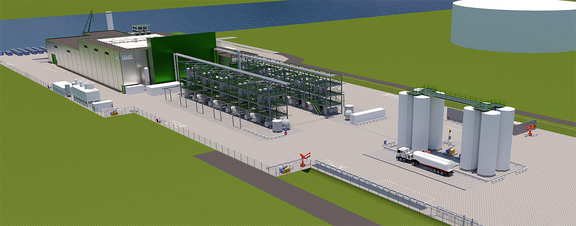
In Rotterdam's Europoort, Xycle is building a chemical recycling factory for plastics that are currently still being incinerated, ending up in landfill or in the natural environment. The factory will soon be able to convert 21,000 tonnes of this plastic waste per year into high-quality raw materials for the chemical industry. By applying proven pyrolysis technology, Xycle's process emits significantly less CO₂ than incineration. ‘We were looking for an engineering firm that could help us move forward quickly with scaling up the technology and (partially) engineering the plant. We found that in VIRO.’
The engineering of Europe's first Xycle plant is divided into the disciplines of Civil, Electrical & Instrumentation (E&I) and Piping & Mechanical Engineering (ME).
We talk to Job Buijze and Luuk Straatman, respectively area manager and project engineer responsible for Piping & Mechanical.
The technology used by Xycle is a proven concept, originating from the Indian company PATPERT TEKNOW SYSTEMS. ‘There are more than twenty of these pyrolysis installations in India. Four years ago, we had a test setup built in a container. We started operating it in Moerdijk to show the world that this process also works on a small scale.’ After India, the process also proved successful in the port area of Brabant. This brought investors Dow, ING, Invest-NL and Vopak on board. Polestar Capital also provided a loan. ‘We can now seriously start scaling up. This plant in Europoort is the first in Europe, but our shareholders are already looking at suitable locations in other countries.’
Xycle's chemical recycling technology uses low-temperature pyrolysis to break down plastic waste into pyrolysis oil. This oil is then used as a raw material for the production of new circular plastic. The first step in the process is to remove non-processable elements from the plastics. After the cleaned plastic has been converted into pellets, these enter the pyrolysis process: ‘We have ten pyrolysis units for this purpose. In these reactors, we vaporise the pellets and then condense the gas that is released. From the pyrolysis process, we ultimately separate the usable circular streams: oil and gas.’
Engineering the Rotterdam plant required a great deal of flexibility and improvisational talent. The proven technology of the test setup had to be scaled up to factory level. The technology from India had to comply with European legislation and regulations. Last but not least, the “paper” principles had to be modelled in practice. The design was regularly revised: 'Initially, we were only looking for a 3D modeller to improve our existing 3D model, because it did not meet our practical needs. VIRO responded quickly to the request and we hit it off right away.

The 3D model of the plant is mainly based on the piping, for which VIRO also performed the stress calculations fairly soon after the initial meeting. "The 3D model also includes the steel structure, for example, which was supplied by Civiel. Other components, such as the DeNOx system and the burner, were supplied ready-made by the suppliers and we fitted them into the 3D model. We were then able to continue engineering on that basis. In short, we kept incorporating elements and adapting the engineering of the plant to the progress made in practice."
The piping and mechanical engineering, and that of the entire plant, had to continuously respond to incoming designs and hardware (and requirements) from Civiel, E&I and suppliers. In this technological pandemonium, VIRO acted as Job and Luuk's helpful right-hand man: "It is ideal that VIRO is not only at home in mechanical engineering and piping and stress calculations, but also in all other disciplines of engineering, including E&I and Construction & Architecture. They worked flexibly and scaled up and down immediately where necessary and possible. We were able to communicate with them quickly. And they are good, hospitable people."
VIRO successfully completed the engineering for the entire plant for this project. We created a detailed 3D model of the factory, provided the production drawings for the piping, steel structures and general layout, among other things, and supplied calculations and metadata for the permit procedures, among other things. ‘We are very satisfied with the collaboration with VIRO; the factory is scheduled to start operating at the end of 2026.’
With thanks to Xycle.
What can we do for you? Please contact us.